Cryoneurolysis: A Minimally Invasive Solution for Chronic Pain After Knee Replacement
A Deeper Dive into Cryoneurolysis: A "Cold" Revolution for Chronic Post-Knee Replacement Pain
For the vast majority of patients, total knee replacement (TKA) is a life-changing procedure that successfully eliminates chronic pain and restores mobility. However, a significant minority, some studies suggest up to 20%, continue to experience persistent, debilitating pain long after surgery. This lingering discomfort can be a frustrating and confusing reality, often leaving patients and doctors searching for answers beyond the standard recovery path.
When the pain isn’t caused by a mechanical issue with the implant or a post-surgical complication like infection, it’s often a “nerve” problem. This is where a cutting-edge, non-surgical treatment called cryoablation for knee pain, also known as cryoneurolysis, is providing hope and lasting relief.
About
Tarabichi Joint Care
At Tarabichi Joint Care, we are dedicated to offering world-class orthopedic care with a focus on joint health and comprehensive rehabilitation. Founded by the renowned Dr. Samih Tarabichi, a pioneer in joint replacement in Dubai, our center stands as a beacon of excellence in the Middle East and beyond. With cutting-edge technologies, a patient-centered approach, and a team of highly specialized professionals, we strive to enhance the quality of life for individuals suffering from joint-related conditions.

Cryoneurolysis Procedure: How Cryoablation Works for Post-TKA Pain?
The Science of “Freezing” Pain
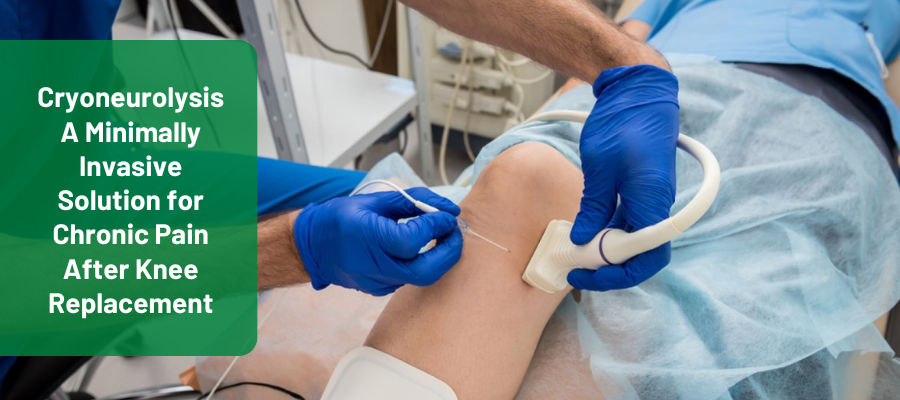
At its core, cryoneurolysis for knee pain post-total knee arthroplasty (TKA) is a clever application of an ancient concept: using cold to numb pain. The procedure targets the genicular nerves, which are the specific sensory nerves responsible for transmitting pain signals from the knee joint to the brain.
Imagine these nerves as electrical wires. During cryoablation, a doctor uses a specialized probe, known as a cryoprobe, to deliver extremely cold temperatures, as low as -60°C to -80°C, directly to the nerve. This carefully controlled “freeze” temporarily disrupts the nerve’s ability to conduct pain signals. Crucially, the freezing process damages the nerve’s internal structure (the axon) but leaves the outer protective layer (the myelin sheath) intact. This preservation of the “nerve’s skeleton” is key.
It ensures that when the nerve regenerates over the next few months, it regrows along the correct path, allowing for normal function to eventually return while providing a long-lasting window of pain relief.
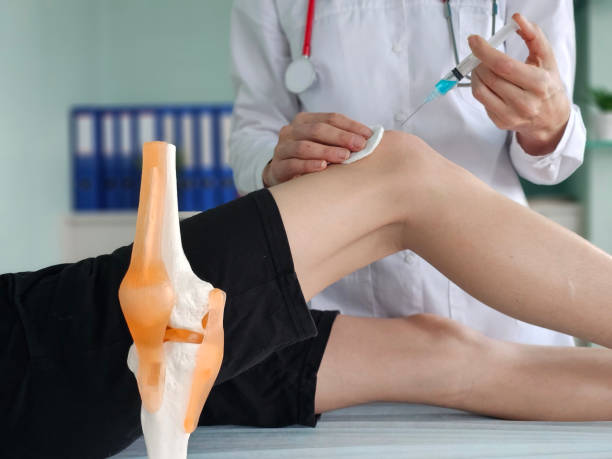
The cryoneurolysis procedure is a minimally invasive, outpatient treatment. Under imaging guidance (such as ultrasound or fluoroscopy) to ensure pinpoint accuracy, a small needle-like probe is inserted through the skin to the targeted nerves around the knee. The process itself is often described as feeling like a brief, cold pressure.
The Clinical Evidence: More Than Just a "Cool" Idea
Cryoablation’s growing popularity isn’t just based on patient anecdotes; it’s supported by a body of clinical research. Multiple studies have shown that cryoablation is an impactful method for pain management after knee surgery. It can significantly decrease pain and improve function in patients with chronic knee pain, particularly after a failed course of conservative treatments.
- Pain Reduction: Research has consistently demonstrated a substantial reduction in pain scores, with many patients reporting over a 40% decrease in their pain levels that lasts for several months.
- Improved Function and Mobility: With pain signals “turned down,” patients are better able to participate in physical therapy, leading to improvements in their range of motion and overall functional recovery. This is a critical factor for regaining a high quality of life.
- Reduced Opioid Use: One of the most significant advantages is the potential to reduce or even eliminate the need for opioid pain medications. This is a major win for patients who are concerned about the risks of long-term opioid use and dependence.
- Safety and Repeatability: Cryoablation has an excellent safety profile. The most common side effects are temporary numbness, swelling, or bruising at the injection site. Because the nerve damage is reversible, the procedure can be safely repeated if the pain returns, offering a sustainable, non-surgical option for long-term pain management.
Potential Side Effects and Risks
While cryoablation is generally considered safe, there are some potential side effects and risks, which are usually minor and temporary:
- Temporary Numbness or Tingling: The most common side effect is a temporary change in sensation, such as numbness or tingling, in the area treated. This usually resolves as the nerve regenerates.
- Soreness, Swelling, or Bruising: The injection site may be sore, swollen, or bruised for a few days after the procedure.
- Other Risks (Rare): As with any procedure that involves a needle, there is a small risk of bleeding, infection, or more serious nerve damage.
Who is a Good Candidate for Cryoablation?
Cryoablation nerve freezing treatment is not for every patient with a painful knee. It is most effective for those whose pain is primarily “neuropathic,” meaning it originates from the nerves, rather than from an issue with the joint implant itself.
A patient may be a good candidate if they:
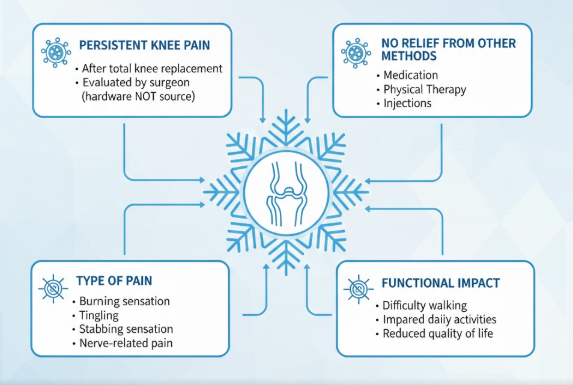
- Have persistent, chronic knee pain after total knee replacement.
- Have been evaluated by their surgeon, and it has been determined that the TKA hardware is not the source of the pain.
- Have not found adequate relief from other non-surgical methods like medication or physical therapy.
- Are experiencing a type of pain that feels like a burning, tingling, or stabbing sensation, often a sign of nerve-related pain.
Before undergoing the full cryoablation procedure, a diagnostic nerve block is often performed. If a temporary anesthetic injection effectively numbs the pain, it provides strong evidence that the genicular nerves are the cause of the problem, making the patient an ideal candidate for genicular nerve cryoablation.
In summary, for the population of patients struggling with persistent pain after a knee replacement, cryoablation offers a powerful, minimally invasive, and non-opioid solution. By “freezing” the pain signals, it can restore a patient’s ability to participate in physical therapy, reduce their reliance on medication, and ultimately help them achieve the pain-free, active life they were hoping for from their knee replacement.
Groundbreaking Research from Tarabichi Joint Care Published in Top Orthopedic Journal
We are proud to announce that our latest research has been published as the lead article in the Journal of Orthopedic Experience & Innovation (USA), partaken by Founder, Dr. Samih Tarabichi, and Director, Dr Mohammed Elfekky of the Tarabichi Joint Care Enhanced Recovery Institute.
The groundbreaking technique highlights Intraoperative CryoNeurolysis, which uses controlled freezing during knee replacement surgery to target pain-transmitting nerves.
This innovation is aimed to redefine global standards in pain management after knee surgery.
Tarabichi Joint Care: A Personalized, Proven Approach
In conclusion, cryoneurolysis offers a promising, minimally invasive option for patients experiencing persistent pain after knee replacement, helping restore comfort without additional surgery or long-term medication use.
At Tarabichi Joint Care, this advanced pain management approach is delivered with a patient-first philosophy, combining cutting-edge technology with deep expertise in joint health. By targeting the source of pain and supporting faster functional recovery, Tarabichi Joint Care remains committed to helping patients move more freely, regain confidence in their knees, and return to an active, pain-controlled lifestyle.

Get Your Appointment For Expert Joint Care
At Tarabichi Joint Care, we are dedicated to providing exceptional orthopedic treatment in Dubai. We specialize in the Enhanced Recovery Program, which emphasizes on quicker healing post-surgery. If you’re considering knee replacement surgery, let us help you on your journey to pain-free living.