What Is Revision Knee Replacement? When and Why Is It Needed?
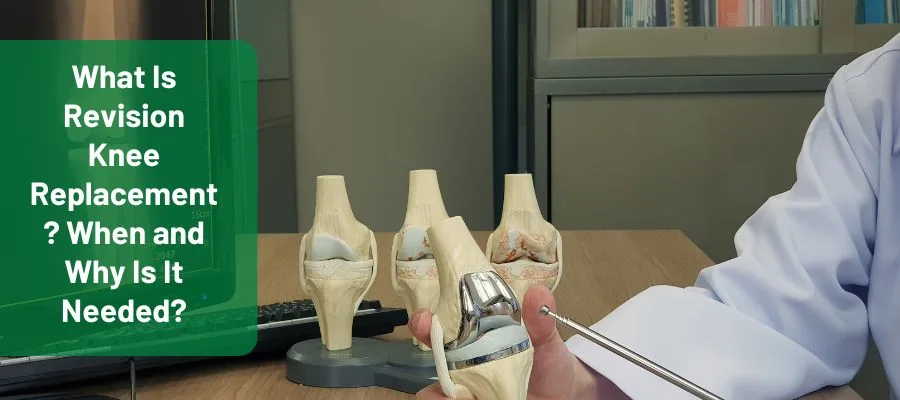
Most people opt for knee replacement, expecting one clear outcome: less pain, smoother walking, and a knee they can trust again. In many cases, that is precisely what happens.
But a small number of patients develop problems months or years later. When the first implant no longer functions as intended, a second operation may be necessary. That second operation is called a revision knee replacement.
A revision is not “doing the same surgery again.” It is a correcting procedure that removes part or all of the old implant, treats the cause of failure, and rebuilds knee stability, allowing the knee to function safely. Because the knee has already been operated on, the tissues may be scarred, the bone may be thinner, and the new implant may need extra support. That is why revision knee replacement surgery is usually more complex than a first-time knee replacement.
In this blog, you will understand what revision surgery means, why it becomes necessary, the warning signs to watch for, what recovery commonly looks like, and when to see a revision knee replacement specialist.
About
Tarabichi Joint Care
At Tarabichi Joint Care, we are dedicated to offering world-class orthopedic care with a focus on joint health and comprehensive rehabilitation. Founded by the renowned Dr. Samih Tarabichi, a pioneer in joint replacement in Dubai, our center stands as a beacon of excellence in the Middle East and beyond. With cutting-edge technologies, a patient-centered approach, and a team of highly specialized professionals, we strive to enhance the quality of life for individuals suffering from joint-related conditions.
What Counts as a Revision Knee Replacement?
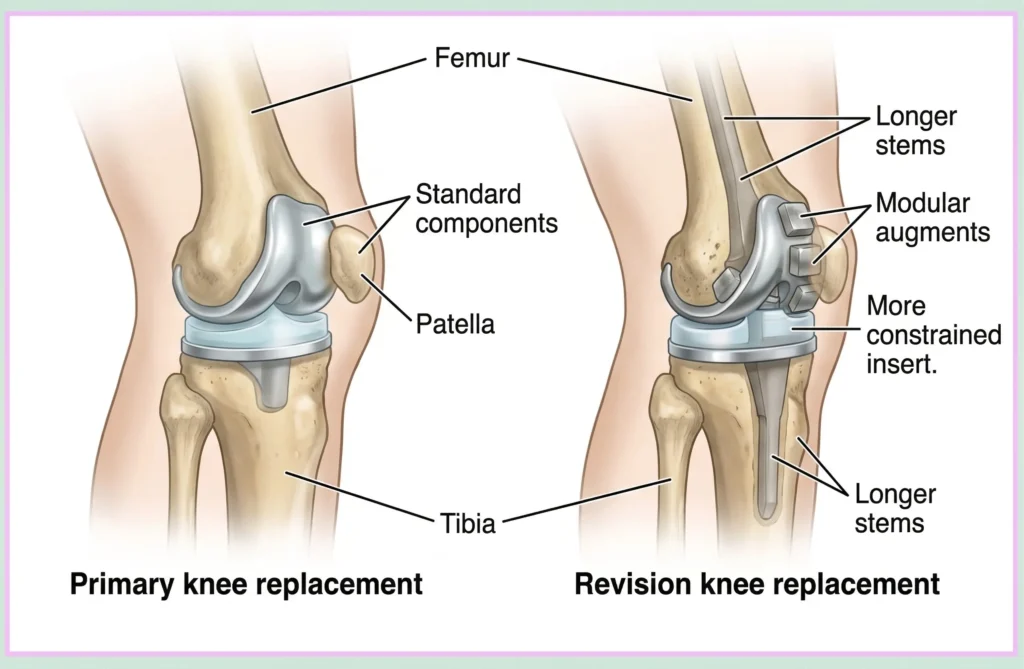
A revision knee replacement surgery is a procedure in which an orthopaedic surgeon replaces a failed or painful knee implant with a new one.
It may involve:
- Partial revision: Only one component is exchanged (for example, the plastic liner)
- Full revision: Most or all implant parts are removed and replaced
- Staged revision: Often used when infection is involved, with surgery done in steps
Many people also seek “total knee replacement revision surgery” after a previous total knee replacement.
Why is Revision Knee Replacement Needed?
A knee implant is designed to last for years, but it remains a mechanical device within a living joint. Over time, certain complications can interfere with comfort and function. Common reasons include:
- Implant Loosening
If the implant loses its secure hold on bone, the knee may start hurting during standing or walking. Loosening occurs gradually and often causes deep, persistent discomfort rather than sharp pain.
- Infection
Infection can appear soon after surgery or many years later. It can lead to swelling, warmth, drainage, fever, or increased pain. Infected implants are usually not treatable with tablets alone. Revision is often required to clear the infection and rebuild the joint safely.
- Wear and Tear Over Time
The plastic spacer between metal parts can wear down. Small particles may irritate the joint lining and contribute to the loss of bone density. This is more likely in younger or highly active patients.
- Instability
People describe their knee as “shifting,” “buckling,” or feeling unsafe when turning or going up stairs. Instability can come from ligament imbalance, implant design issues, or component loosening.
- Stiffness and Loss of Motion
If the knee becomes progressively stiff and physical therapy no longer provides relief, the underlying cause must be investigated. Stiffness can result from scar tissue, malalignment, or mechanical issues within the joint.
- Implant Malposition or Wrong Sizing
Even minor alignment problems can create uneven pressure. Over time, this may cause pain, early wear, or an unstable feel.
- Fracture Around the Implant
Trauma leads to a fracture near the prosthesis. A revision is required to restore stability and rebuild the joint surfaces.
Knee Replacement Revision Symptoms You Should Not Ignore
People often wait because they assume pain is part of ageing or “normal after surgery.” The problem is that mechanical issues typically worsen when left unaddressed. Common knee replacement revision symptoms include:
- Pain that persists, returns, or steadily worsens after an initial good phase
- Swelling that keeps coming back
- Warmth, redness, wound leakage, or fever (possible infection)
- A knee that feels unstable or gives way
- New clicking, grinding, or a shifting sensation while walking
- Difficulty bending or straightening the knee
- Reduced walking distance or trouble with stairs due to pain or stiffness
If any of these symptoms appear, it is sensible to consult your surgeon or a revision knee replacement specialist. Early assessment can help prevent bone loss and reduce the complexity of revision surgery.
Confirmation of Cause Before Recommending Surgery
Before recommending total knee replacement revision surgery, surgeons usually review:
- Your medical history and current limitations
- Physical examination focused on stability, motion, and pain pattern
- X-rays for checking the alignment, loosening, and implant position
- Blood tests to screen for infection markers
- Joint fluid aspiration if infection is suspected
- Advanced imaging is needed to assess bone loss or component issues
This step is essential because treatment depends on the cause. A loose implant is treated differently from a deep infection, and both differ from stiffness caused by scar tissue.
Revision Knee Replacement Surgery Procedure
While every case is different, the common stages include:
- Removal of the old implant
This can be challenging if the implant is well-fixed or surrounded by scar tissue.
- Cleaning and preparing the bone
The surgeon removes damaged tissue and assesses bone quality.
- Managing bone loss if present
Bone grafts, metal augments, or specialized revision components may be used.
- Placing a new implant designed for revision
Revision implants are often more supportive, sometimes with longer stems for stability.
- Balancing the knee
Stability is checked through bending and straightening before closing.
Because it is more complex, revision surgery typically takes longer than a first-time replacement.
Revision Knee Replacement Recovery Timeline
Knee replacement revision recovery time varies based on the reason for revision, the amount of reconstruction needed, and your health status. Still, most patients can expect a slower, more deliberate recovery than after a primary replacement.
In the hospital
- A few days of monitoring are needed
- Pain control, early walking, and clot prevention start quickly
- Therapy begins early to protect motion and strength
The first 6 to 12 weeks
- Walking improves step by step, often with a walker or cane, early on
- Swelling can last longer than after the first replacement
- Therapy focuses on motion, strength, and gait correction
Longer-term recovery
Many patients continue improving for several months. Full recovery may take up to 6 to 12 months, especially when the revision involved infection treatment, bone loss, or major reconstruction.
Risks of Total Knee Replacement Revision Surgery
Revision surgery brings relief, but it does carry risks. Common concerns include:
- Infection
- Blood clots
- Stiffness
- Nerve or blood vessel injury (rare)
- Ongoing pain or slower-than-expected improvement
A surgeon reduces risk through planning, careful technique, and guided rehabilitation, but it is still essential for patients to understand that revision is not a “simple fix.” It is a rebuild.
How Can Revision be Prevented?
Not all revisions are avoidable, but you can lower the chances of problems by:
- Keeping follow-up visits, even when you feel fine
- Managing weight and blood sugar, if relevant
- Treating infections anywhere in the body promptly (dental, urinary, skin)
- Avoiding high-impact activities unless your surgeon clears them
- Reporting new swelling, instability, or persistent pain early
Why Choose Tarabichi Joint Care for Revision Evaluation?
Revision needs careful decision-making, not rushed surgery. A thorough assessment by a revision knee replacement specialist helps confirm whether you need targeted non-surgical care or total knee replacement revision surgery, and it also helps prevent further bone loss or complications.
Tarabichi Joint Care in Dubai prioritizes advanced joint care, with a strong emphasis on recovery, supported by modern techniques and structured post-operative planning. Key strengths include:
- Expert-led assessment for complex knee problems, including revision cases
- A focus on safer, faster recovery through the Enhanced Recovery Program approach
- Advanced pain-management techniques. Particularly aimed at reducing reliance on heavy medication
- Effective joint care experience with a strong emphasis on functional outcomes
- Support for international patients, including logistics and coordinated follow-up
Tarabichi Joint Care is renowned for innovations in joint replacement and surgeon training, along with an experienced team that specializes in advanced knee procedures and minimally invasive approaches, utilizing advanced techniques to reduce pain.
When a Knee Replacement Stops Working, You Still Have Options
A knee replacement is designed to restore comfort and function in the long run, so it can be discouraging when pain, swelling, or instability return. Still, these changes are not something you have to live with.
The cause can be clearly identified, and a well-planned revision knee replacement can restore stability, reduce pain, and help you return to everyday activities with more confidence.
The key is early treatment and expertise if you notice knee replacement revision symptoms, such as worsening pain, recurrent swelling, stiffness that limits daily activities, or a feeling that the knee may give way, seek an evaluation early.
At Tarabichi Joint Care, patients benefit from advanced diagnostic planning and a recovery-focused approach built around comfort, safe mobility, and structured rehabilitation. To discuss your symptoms, review your prior surgery details, or obtain a second opinion, schedule a consultation with our team and take the next step toward steady, pain-free walking again.

Get Your Appointment For Expert Joint Care
At Tarabichi Joint Care, we are dedicated to providing exceptional orthopedic treatment in Dubai. We specialize in the Enhanced Recovery Program, which emphasizes on quicker healing post-surgery. If you’re considering knee replacement surgery, let us help you on your journey to pain-free living.